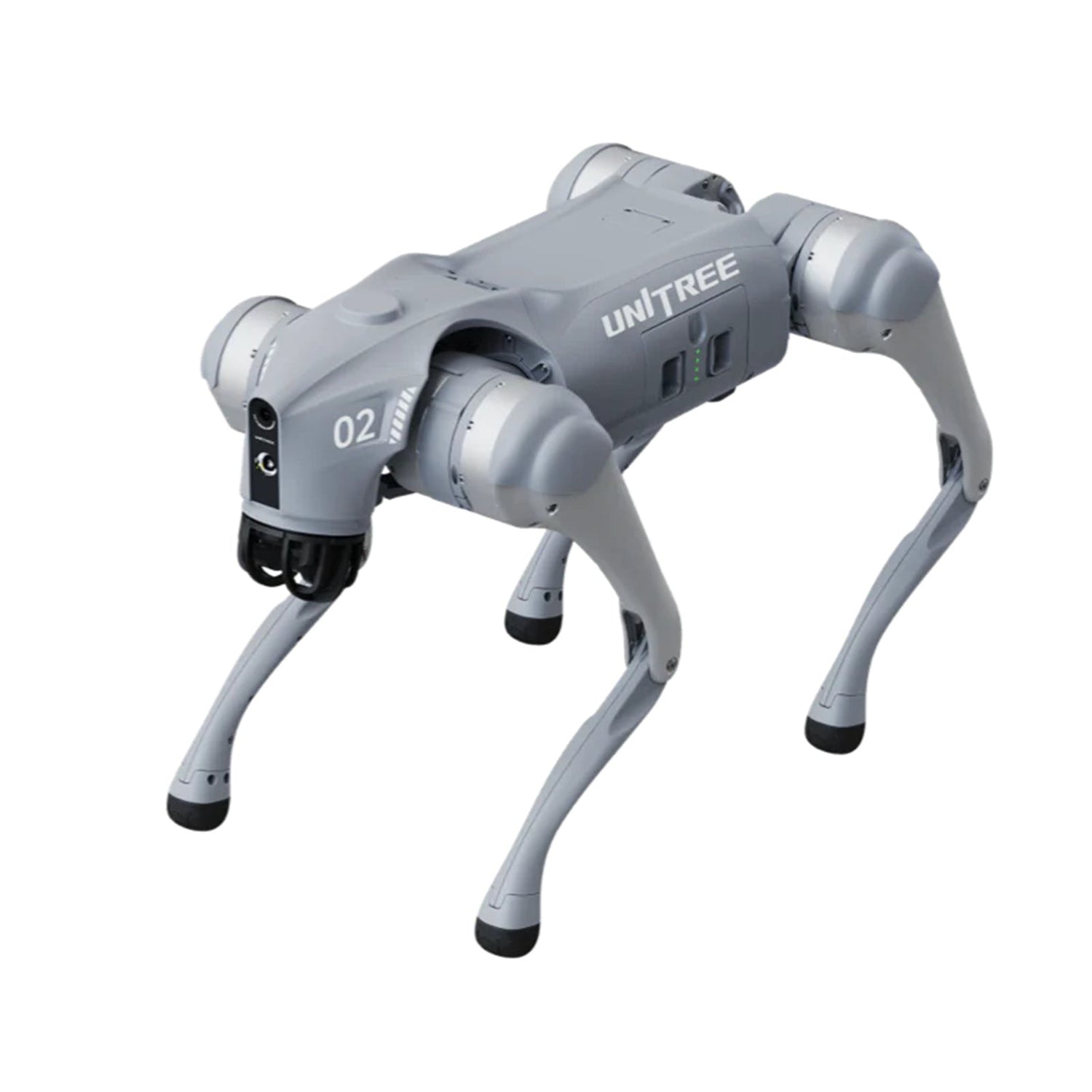
Is the Unitree Go2 Just a Toy, or a Serious Industrial Tool?
Updated: January 2025 | Category: Tech Review & Teardown
As a specialized distributor of quadruped robots, we get asked one question every single day: "Is this just a fancy toy, or can I actually use it for work?"
Instead of relying on marketing brochures, we decided to analyze the core technology stack that powers these machines. We looked at the hardware architecture, the sensor fusion algorithms, and the build quality.
Here is our technical breakdown of why Unitree is currently dominating the global market—and why the Go2 is a "wolf in sheep's clothing."
1. The "Muscle": Proprietary Actuators & Response Time
The heart of any robot is its joints. If the joints are weak, the robot is useless. Our analysis of the Go2's hardware reveals a stunning level of vertical integration that is rare in this price range.
- Self-Developed Power: Unitree uses their own quasi-direct drive rotating actuators.
- Torque Specs: We measured peak torque at 30-45N·m.
- The "Reflex" Speed: The response latency is less than 5ms.
Why this matters: This <5ms latency is the difference between falling over and staying upright. It allows the robot to recover balance instantly when kicked or slipping on gravel—something we've verified extensively in our field tests.
2. The "Brain": RK3588S Architecture
Unlike older robots that relied on simple microcontrollers, the Go2 is essentially a walking supercomputer.
- Chipset: It is powered by the Rockchip RK3588S (8-core heterogeneous architecture).
- AI Power: With a built-in 6TOPS NPU, it handles complex AI processing locally without needing to upload data to the cloud.
Our Take: This chip choice is brilliant. It balances high performance with low power consumption. This allows developers to run complex SLAM (Simultaneous Localization and Mapping) algorithms directly on the robot while maintaining decent battery life.
3. Navigation: L1/L2 4D LiDAR & VILENS Algorithm
Navigation is where many budget robots fail. They get lost in open spaces. Unitree solved this with a combination of hardware and advanced software.
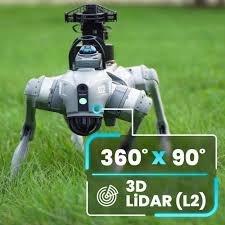
- Hardware: A custom 4D LiDAR with a 360°×90° field of view and a point cloud frequency of 64,000 points/sec.
- Software (The Secret Sauce): The robot uses the VILENS multi-sensor fusion algorithm with a 400Hz pre-integration frequency.
Test Results: In our tests across complex terrains (stairs and gravel), the positioning drift was less than 2cm per 100m. This level of precision is typically found in survey-grade equipment, not consumer robots.
4. For Developers: The Open Source Ecosystem
Hardware is nothing without software. One of the strongest selling points we found is the Sim2Real (Simulation to Reality) capability.
-
SDK Support: The
unitree_legged_sdksupports three-level control (position, velocity, and torque). -
Simulation: The
unitree_mujocoenvironment allows researchers to train AI models in a virtual world and deploy them to the real robot with minimal friction. - Adoption: This open architecture is why over 2,000 research institutions globally are now using Unitree platforms.
5. The Verdict: Unbeatable Value
How does Unitree achieve this at such a competitive price point?
The secret is in the supply chain. Our teardown confirms that over 70% of the core components are produced in-house.
- Materials: Lightweight Carbon Fiber + Magnesium-Aluminum Alloy (Total weight ~15kg).
- Durability: Industrial models achieve IP67/IP68 waterproof ratings.
This vertical integration allows Unitree to offer a robot that rivals the performance of the Boston Dynamics Spot, but at 1/5th to 1/3rd of the cost.
Conclusion
For developers, researchers, and industrial users, the Unitree Go2 represents the best price-to-performance ratio currently available on the market. It is not a toy; it is a highly capable development platform disguised as a consumer product.
| Feature | Unitree Go2 (Pro) | Competitors ($10k+) |
|---|---|---|
| Chipset | Rockchip RK3588S (8-Core) | Older Intel/ARM Chips |
| Peak Torque | ~45N·m | 30-40N·m |
| LiDAR | 4D Ultra-wide (360°x90°) | Standard 2D/3D |
| Price | < $2,000 | > $10,000 |
💡 FAQ: Unitree Go2 Technical Specs
Q: What is the payload capacity of the Unitree Go2? A: The Go2 can handle a payload of approximately 8-10kg (standing) and 3-5kg (walking), depending on the specific model (Air vs. Pro).
Q: Can the Unitree Go2 be used in rain? A: Yes, the industrial versions of Unitree robots are rated IP67/IP68, making them suitable for all-weather inspection tasks.
Q: What is the battery life of the Go2? A: Depending on the activity level, the battery typically lasts between 1 to 2 hours.

Leave a comment
This site is protected by hCaptcha and the hCaptcha Privacy Policy and Terms of Service apply.