Key Takeaways
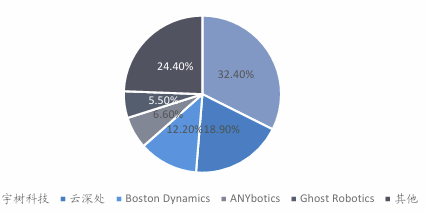
- Market Leader: Unitree Robotics holds the #1 global spot with 32.4% market share.
- Consumer Shift: 84.5% of all quadruped robots sold are now consumer-grade (Education & Entertainment), eclipsing industrial use.
- China's Dominance: Chinese manufacturers (Unitree + Deep Robotics) control over 50% of the global market.
- Western Competitors: Boston Dynamics holds 12.2%, focusing strictly on high-end industrial sectors.
The 2024 Landscape: The Rise of the Consumer Robot Dog
The quadruped robot industry has reached a historic tipping point in 2024. According to the latest data from IDC and industry analysis, the era of the "robot dog" being solely a million-dollar industrial tool is over.
The market has decisively shifted toward accessibility, driven by supply chain maturity and technological breakthroughs in cost reduction.
1. Consumer vs. Commercial: The 80/20 Split
The most shocking statistic from the 2024 data is the product composition:
- Consumer-Grade Robots: 84.5%
- Commercial-Grade Robots: 15.5%
What this means for buyers: The market volume is being driven by education, research, and entertainment. Robots are no longer just for inspecting oil rigs; they are in classrooms and living rooms. This "strong accessibility and interactivity" is pushing the technology into the mainstream.
2. Global Market Share: Who is Winning?
The competitive landscape has solidified, with Chinese manufacturers building a "solid competitive barrier" through superior supply chains and rapid iteration.
The Top 5 Players in 2024:
- Unitree Robotics (32.4%): The undisputed global leader. By offering a full range of products—from the affordable Go2 for consumers to the industrial B2 for enterprise—Unitree has captured nearly a third of the entire planet's market.
- Deep Robotics (18.9%): Another major Chinese player, securing the second spot.
- Boston Dynamics (12.2%): The American pioneer remains a key player but focuses on a lower-volume, higher-price niche.
- ANYbotics (6.6%): Swiss-based, focusing on specialized industrial inspection.
- Ghost Robotics (5.5%): Primarily focused on defense and security applications.
Combined Impact: Together, Unitree and Deep Robotics control over 51% of the global market. This signals a shift in the center of gravity for robotics hardware manufacturing from the West to the East.
3. Why Unitree is Outperforming Boston Dynamics in Volume
While Boston Dynamics’ Spot remains an engineering marvel, its high price point limits its market share to 12.2%.
In contrast, Unitree (32.4%) has successfully democratized the technology. By leveraging the massive consumer electronics supply chain, Unitree has managed to:
- Lower the entry barrier for developers and educators.
- Provide "Pro" features (like LiDAR and AI motion control) at a fraction of the cost.
- Dominate the high-volume consumer segment (the 84.5% slice of the pie).
4. The Future Outlook
The data suggests that 2024 is the year of mass adoption. As the consumer segment continues to hold the absolute dominant position, we expect to see:
- More Software Ecosystems: With more hardware in users' hands, third-party apps for robot dogs will explode.
- Lower Prices: Economies of scale from the 84.5% consumer volume will further drive down costs for industrial models.
Conclusion
If you are looking to invest in a quadruped robot in 2024, the market data is clear. For specialized, high-budget industrial tasks, Western brands like Boston Dynamics and ANYbotics remain strong contenders.
However, for the vast majority of users—universities, developers, and tech enthusiasts—Unitree is the market standard, offering the best balance of performance, price, and community support.
FAQ
Q: Who is the market leader in quadruped robots in 2024? A: Unitree Robotics is the global leader with a 32.4% market share, followed by Deep Robotics (18.9%) and Boston Dynamics (12.2%).
Q: Are robot dogs mostly for industry or home use? A: In 2024, the market is dominated by consumer-grade products (84.5%), used primarily for education, entertainment, and development. Only 15.5% are strictly commercial/industrial.
Q: How does Unitree compare to Boston Dynamics? A: Unitree holds a larger market share (32.4% vs 12.2%) because they offer affordable consumer models (like the Go2) alongside industrial models, whereas Boston Dynamics focuses exclusively on high-end industrial applications.

Leave a comment
This site is protected by hCaptcha and the hCaptcha Privacy Policy and Terms of Service apply.